
How Does the Work of Dolce & Gabbana Relate to the Topic of Religious Symbolism in Fashion?
Thursday, February 19, 2026
How Does the Work of Dolce & Gabbana Relate to the Topic of Religious Symbolism in Fashion?
By Maria Antonelli
This analysis critically examines the intersection of religious symbolism and contemporary fashion through the lens of Dolce & Gabbana's creative output. While cultural symbolism has long functioned as a communicative tool in fashion, its contemporary application demands deeper scrutiny, particularly regarding how designers leverage it to negotiate identity and tradition within modern contexts. The distinctive approach of Domenico Dolce and Stefano Gabbana, which interweaves traditional Sicilian Catholic religious motifs with spiritual themes, provides a compelling case study for examining how fashion houses construct meaning through symbolism. This analysis interrogates not only how Dolce & Gabbana deploy symbolism to construct narratives in their designs but also how their utilisation of religious iconography simultaneously communicates tradition while offering contested contemporary interpretations of the sacred. The theoretical framework draws upon Roland Barthes' semiotic approach in "The Fashion System" , Fred Davis' concept of fashion as a "quasi-code" in "Fashion, Culture, and Identity" , Simona Segre Reinach's contextual analysis in "The Berg Companion to Fashion", Håkan Preiholt's temporal perspective in "From Collective Selection to Individual Style" , and Lynn S. Neal's critical examination in "Religion Reprocessed in Dolce & Gabbana's 'Tailored Mosaic’”.
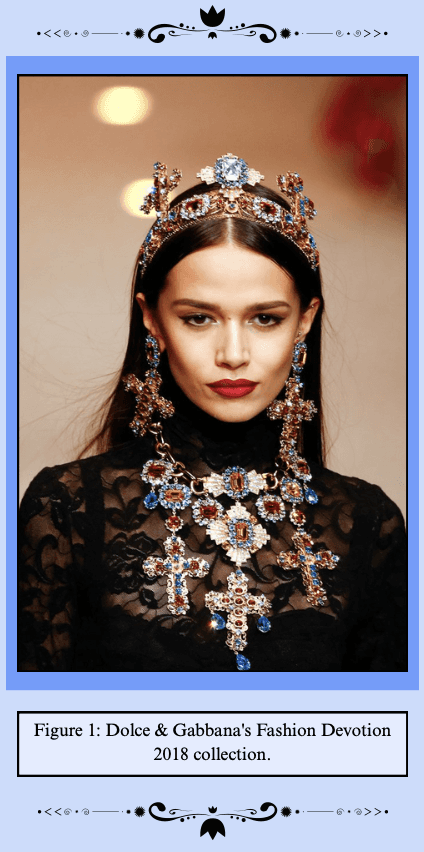
Roland Barthes' semiotic approach positions fashion as a system of signs, where garments function as signifiers that communicate cultural values as the signified. Figure 1 exemplifies this dynamic through a model adorned with a golden crown decorated with red, blue, and silver gems, featuring a central cross, complemented by cross earrings, a necklace, and a sheer black lace blouse from Dolce & Gabbana's Fashion Devotion 2018 collection. Through Barthes' analytical framework, these religious symbols operate simultaneously as A- ensembles connected to spirituality and as B- ensembles linked to abstract fashion trends.
Rather than serving as mere decoration, these symbols become sophisticated communication tools that elevate fashion beyond aesthetics into cultural expression. The collection's reception reveals a polarisation of interpretations; some critics, such as Simona Segre Reinach, perceived the religious aesthetics as authentic tributes to Italian religious tradition. This interpretive divide exposes the limitations of Barthes' framework, which inadequately accounts for the subjective interpretation of religious symbols across different audiences and contexts.
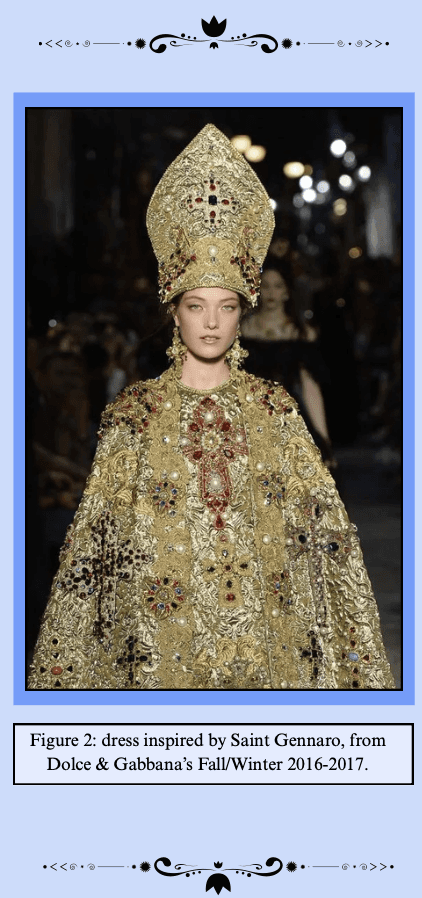
This interpretive ambiguity aligns with Fred Davis's conceptualisation of fashion as an evolving symbolic communication system that functions as a "quasi-code" whose meanings shift according to cultural context, social group, and historical period. This fluidity manifests in Figure 2, which depicts a model in a golden cloak-like dress adorned with crosses and detailed with red and blue elements, complemented by gold cross earrings and a golden ecclesiastical headdress. The exaggerated ornamentation and the model's posture simultaneously evoke power and purity, creating a complex semiotic message. This garment, inspired by Saint Gennaro from Dolce & Gabbana's Fall/Winter 2016-2017 Alta Moda show in Naples, exemplifies the multivalent nature of religious symbolism when examined through Davis's theoretical lens. Indeed, these symbols acquire distinct meanings depending on the observer's perspective—representing genuine spirituality to some while merely signifying fashion trends devoid of religious significance to others. The contemporary relevance of this theoretical position became evident in 2024 when Kim Kardashian's SKIMS X Dolce & Gabbana campaign featured lingerie with rosaries and crosses, triggering outrage among those who perceived disrespect toward Catholicism, while others viewed these elements as merely aesthetic accessories. This controversy demonstrates how interpretations diverge between those who view these symbols as sacred and those who regard them primarily as design elements.
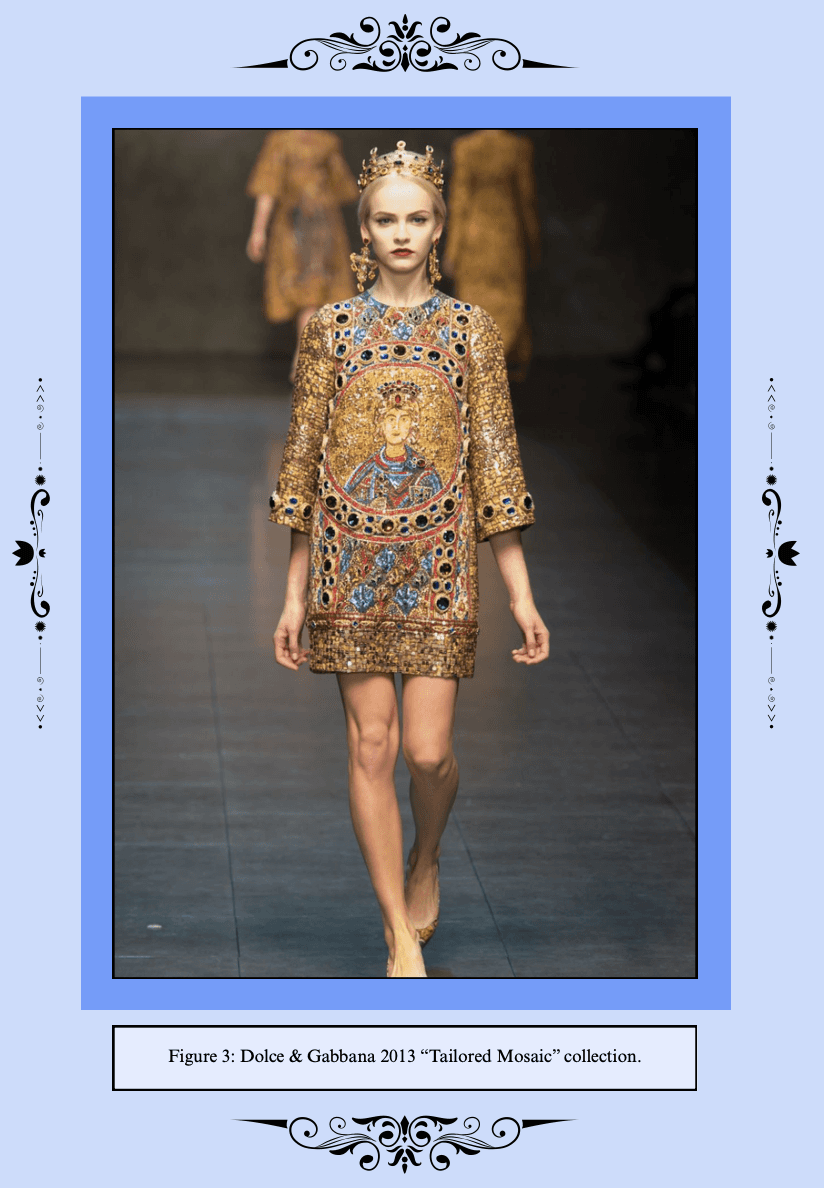
Lynn Neal's critical analysis provides additional interpretive insight into Dolce & Gabbana's symbolic practices. Their approach derives credibility from authentic historical and artistic sources, lending substantive depth to their creative expressions. As Neal argues, "Dolce & Gabbana use real historical and artistic sources, which lends depth and credibility to their designs". This methodological approach becomes evident in Figure 3, which showcases a golden dress inspired by Byzantine mosaics, featuring blue and red details that deliberately evoke religious iconography, complemented by a crown and gold earrings.
The central figure draws directly from Byzantine Christian art, particularly the mosaics of Sicily's Monreale Cathedral, from the 2013 "Tailored Mosaic" collection. Neal's analysis reveals how this collection strategically employs abstract religious symbols such as crowns and royal figures to reference religious iconography without explicit representations of figures such as Christ or the Virgin Mary.
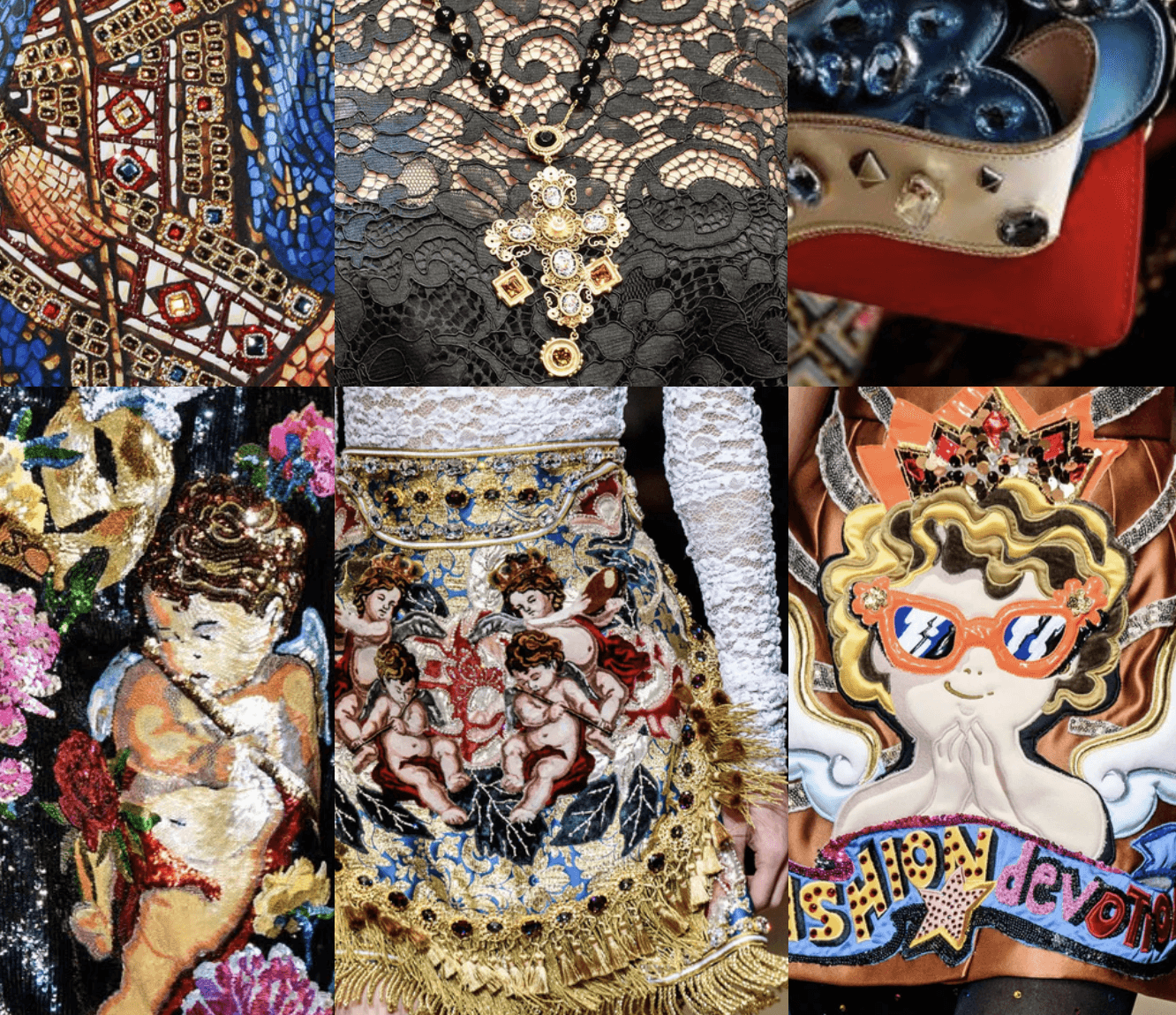
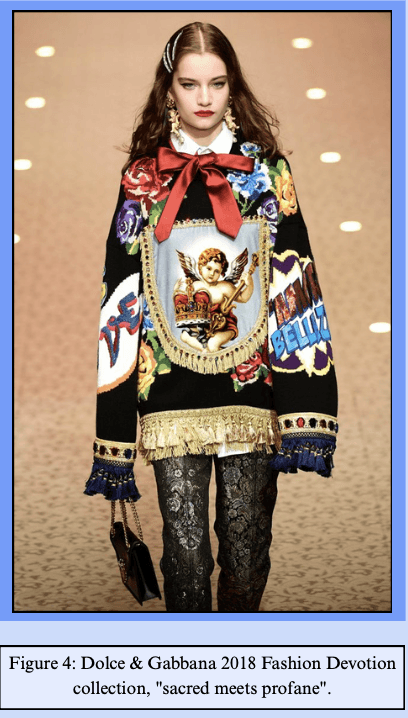
Neal further contends that Dolce & Gabbana's work stimulates critical reflection on the intersection of religion and fashion in contemporary society. This provocative dialogue appears in Figure 4, which presents a model wearing a colourful sweater with floral patterns and inscriptions, centred around a cherub—a Christian symbol of purity and divine love. It is complemented with black lace pants and gold Cupid-shaped earrings, photographed during the 2018 Fashion Devotion collection. While Vogue characterised this collection as "sacred meets profane" and "baroque brilliance" , lending support to Neal's interpretation, critics such as Dr. Marian T. Horvat condemn such designs for what they perceive as harmful profanation of religious symbols. This tension between appreciation and condemnation reveals the contested nature of religious symbolism in fashion.
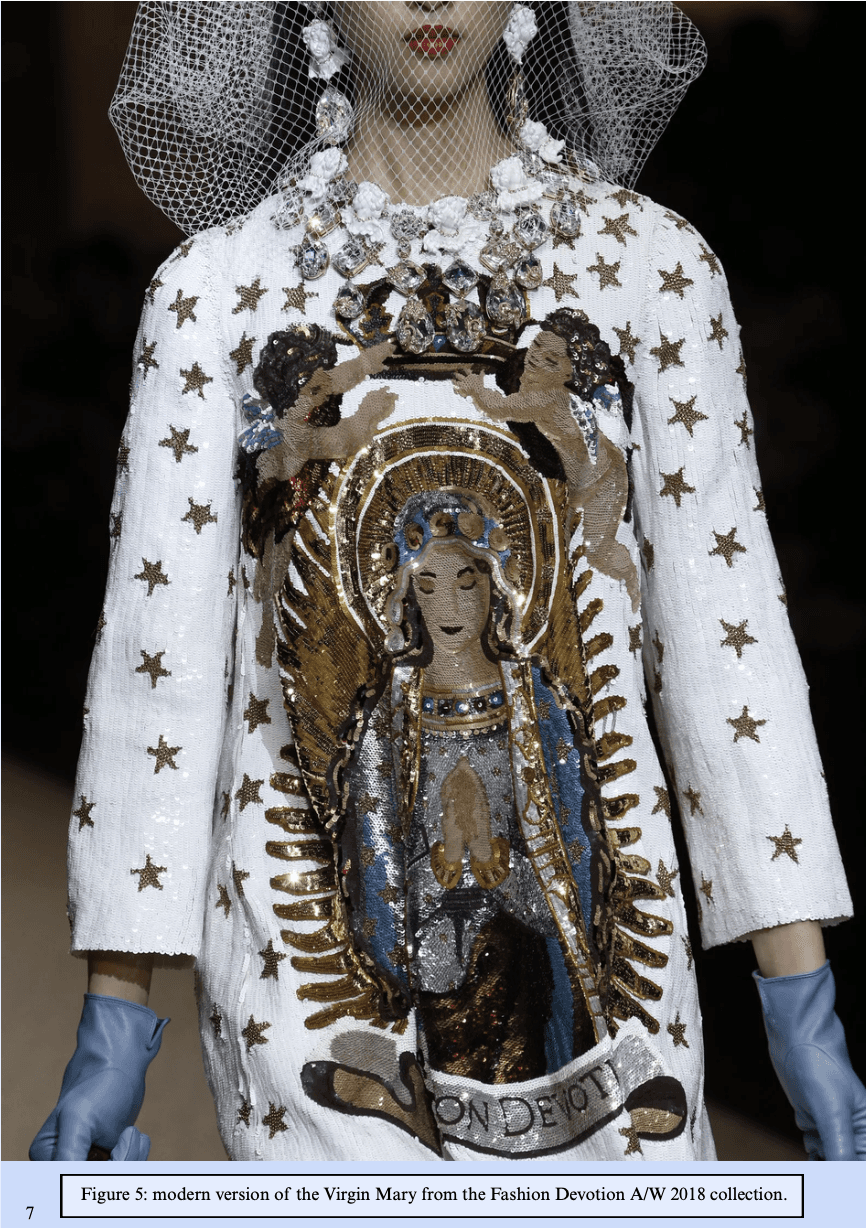
Preiholt adds a temporal dimension to this symbolic discourse, arguing that fashion generates meaning through the continuous reinterpretation of symbols over time, noting that "a recurring redesign of garments gives rise to a fashion that creates symbols". Figure 5 exemplifies this concept through a model wearing a white strass dress adorned with golden stars, featuring an image of the Virgin Mary surrounded by winged cupids, a crown, and the inscription "Fashion Devotion" , completed with a white veil, blue gloves, diamonds, and red lipstick. This representation constitutes a deliberate modern reinterpretation of the Virgin Mary from the Fashion Devotion A/W 2018 collection, transforming sacred figures into fashion icons. This transformation reflects Preiholt's observation that "the initial meaning is created by brands or famous people presenting an individual style to the collective". Influential designers such as Dolce & Gabbana introduce novel interpretations of established symbols, which audiences subsequently adopt and personalise, integrating these re-signified elements into their personal identity expressions.
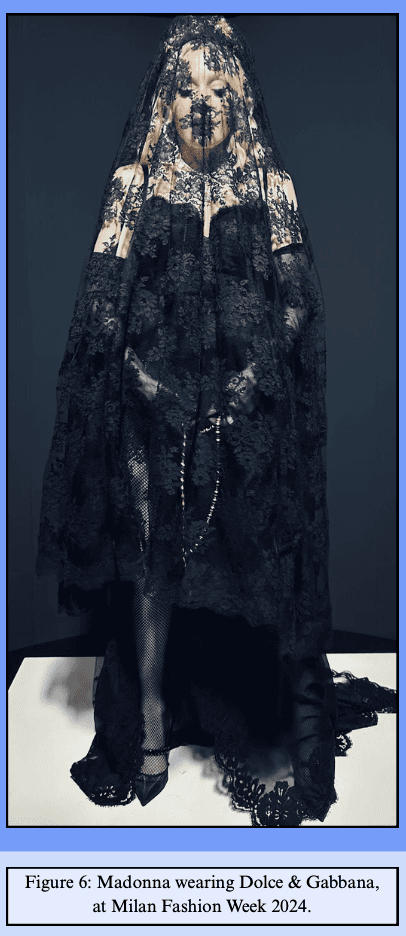
The tension between religious symbolism and provocation characterises Dolce & Gabbana's aesthetic approach, as evidenced in Figure 6, which depicts Madonna in a black corset and lace veil holding a rosary, traditional symbols of respect and mourning in Sicilian Catholic tradition. The ensemble includes long stockings, black gloves, a diamond haute couture necklace, and a gold crown with crystals, photographed during the 2024 Milan Fashion Week. The composition deliberately juxtaposes traditional mourning symbolism with provocative elements such as the corset and stockings, typically associated with sensuality and sexuality, creating tension between reverence and transgression. Simona Segre Reinach contextualises this approach by noting Dolce & Gabbana's distinctive conceptualisation of femininity, employing Christian-inspired decorations that reflect their cultural identity while deliberately blending sacred tradition with modern sensuality. Reinach characterises the Dolce & Gabbana woman as "audacious and bold, but fearful of God and devoted to the church and family, typical of southern Italian Catholicism". This duality between audacity and reverence manifests in Figure 6, where the model's bold appearance creates a productive tension with solemn religious symbolism. While some might see this representation as reducing religious symbols to mere aesthetic elements—raising concerns about cultural appropriation and the commercialisation of the sacred—others might interpret it as a respectful integration of tradition into contemporary artistic expression.
When applied to Dolce & Gabbana's work, the theoretical frameworks of Barthes, Davis, Preiholt, Neal, and Segre Reinach reveal fashion's function beyond aesthetics as a sophisticated communicative language expressing identity and cultural values. The interpretation of religious symbols varies significantly according to perspective—while some dismiss them as mere decoration, others, particularly devout Catholics, perceive them as disrespectful appropriation of the sacred. Conversely, some Catholic individuals view them as authentic tributes to tradition that meaningfully integrate religious symbolism with contemporary artistic expression. The transformation of these symbols into luxury objects demonstrates religion's complex metamorphosis within the fashion market while retaining contested aspects of its cultural significance. Dolce & Gabbana construct multifaceted narratives by employing religion not merely as decoration but as a powerful communicative tool expressing their cultural and identity roots. As Segre Reinach observes, their use of religious symbols celebrates their Sicilian cultural heritage, where religion fundamentally shapes daily life. Through this approach, Dolce & Gabbana integrate sacred symbols and cultural traditions with modern aesthetics and sensuality, establishing a distinctive and recognisable style that transcends fashion to offer profound commentary on the relationship between religion, devotion, and cultural identity. Their designs demonstrate religious symbols' continued influence on contemporary culture, as symbols once exclusively sacred, such as crosses and rosaries, undergo critical reinterpretation on the catwalk, creating a productive tension between tradition and modernity.