
Modern Slavery in the Fashion Industry Through the Lens of Neoliberal Globalisation
Friday, September 25, 2026
By Clara Danzl
Modern Slavery in the Fashion Industry Through the Lens of Neoliberal Globalisation
“What is ethical fashion? It’s a confusing term. Sometimes it’s easier to define by what it isn’t – and unfortunately that is most of what can be found on the high street. Unethical fashion means very very little transparency, accountability and knowledge of the supply chain. It means demands of very quick lead times and production turnaround. It means producers played off against each other. It means a wage that doesn’t even afford the worker an adequate salary for two meals a day.”
— Safia Minney (Founder of People Tree)
Introduction
Slavery is often considered something from the past; however, it is still pertinent in modern times, especially in the global supply chain field. The fashion industry falls under this category – and it became known for the exploitation of its workers. Labour exploitation meets the criteria of modern slavery: use of force, coercion, abuse of vulnerability and deception. Despite the implementation of multiple international laws and empty promises from corporations about ethics, millions of garment workers worldwide continue to suffer under deplorable conditions to produce clothing items for mostly fast fashion brands. This essay will explore the theoretical origins and conceptual assumptions of slavery and its persistence in modern economies. Additionally, this paper will examine how capitalism facilitates bad labour conditions when it comes to the fashion industry, laying a focus on the case study of the 2013 Rana Plaza disaster in Bangladesh, demonstrating how neoliberal globalisation sees exploitation systems.
Theoretical Origins and Conceptual Assumptions of Slavery
Slavery has always existed throughout history – all in different forms. From hierarchical orders and transatlantic slave trade to today’s overlooked coercive labour system. The Natural Law Theory of Aristotle considered slavery as natural and just social norms – where “natural slaves” are people that lack rational capacity and the ability to govern themselves and their subjugation is for the benefit of more “civilised” societies.
During the transatlantic slave trade, slavery was being justified as it was an economic system deeply rooted in race issues, colonialism, and capitalism. Chattel Slavery ensured that enslaved Africans were seen and treated as property, stripped of their rights, and commodified. This was seen as justified due to pioneers like Carl Linnaeus who created scientific racism and different similar thinkers that laid a foundation for global systems of racial and economic inequality that still exist to this day.
Sociologist and historian Orlando Patterson defined slavery as a form of “social death”, where enslaved are denied all rights and get reduced to objects solely for economic gain. His definition remains important for the understanding on how modern slavery strips people of autonomy, identity, and protections.
The International Labour Organisation (ILO) defines modern slavery through terms such as coercion, lack of freedom, and exploitation. Whilst legal ownership no longer defines slavery, functional equivalents – such as debt servitude, forced labour, and unfree contracts – continue to happen disguisedly.
The Rise of Neoliberal Globalisation in Relation to Slavery
Modern slavery thrives because globalisation, which in combination with neoliberalism emphasizes free market economies, privatisation, and little to no state intervention in social welfare. According to David Harvey, neoliberalism is a political project that puts the states’ interest above – and often at the expense – of workers’ rights and the general public.
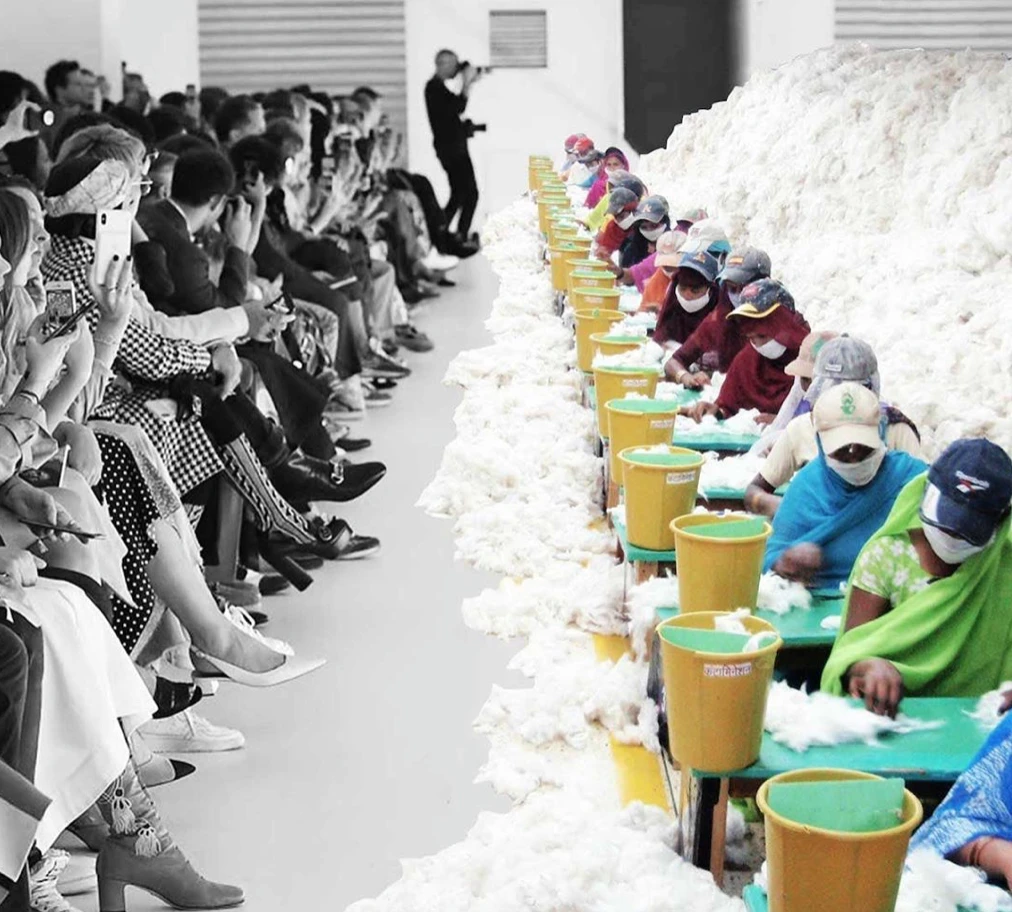
Under this structure, international corporations seek the lowest production cost combined with highest production numbers – all by outsourcing labour to low-income countries with poor regulations. Neoliberalism presents labour as a commodity and workers as tools, often neglecting their well-being. The pressure to reduce production costs and increase profits pushes companies to rely on supply chains, where exploitation is created.
The World-systems theory by Immanuel Wallerstein adds to this analysis by stating that the global economy is structured into two different nations – “core” and “peripheral”. Core countries exploit peripheral countries for their cheap labour and raw materials – something that can be clearly seen in the fashion industry, where wealthy nations, like the US and EU countries, benefit from low-cost labour in countries, like Bangladesh and India.
Essentially, modern slavery is a contemporary problem that is being made possible – and in many ways encouraged – by the current global economies rather than a relic from a pre-modern past. It is a natural byproduct of a global system, where profit maximisation and economic efficiency step over human rights, rather than only a result of poverty or poor government.
Case Study of Modern Slavery in the Fashion Industry
The fashion industry, particularly fast fashion, prospers mainly on rapid production and low costs. This model creates a lot of pressure on suppliers in the Global South. This often leads to exploitative and unsafe working environments that constitute to modern slavery.
A known example is the Rana Plaza disaster in the Dhaka region, Bangladesh. On April 24 of 2013, the eight-story commercial building housing several garment factory workers collapsed, killing over 1,100 and injuring thousands. Workers had already identified many cracks in the building walls and notified their bosses about it. On the day of the disastrous event, the workers first refused to enter the building but were later forced back with threats on their wages. The lack a protected work environment and systemic disregard for safety regulations clearly exemplify key indicators of modern slavery.
The brands that had recently placed orders to factories at the Rana Plaza included Primark, Benetton and Texman. Other investigations revealed that companies like Shein and H&M used factories in which workers face 12-18-hour days with below-minimum wages and denial of union rights. These conditions continue to happen because of a system of dependency and fear of workers towards their bosses.
Critique of Theoretical Assumptions and Propositions
Many problematic assumptions involve both historical and modern forms of slavery. Whilst voluntary standards and Corporate Social Responsibility (CSR) codes are in place, they almost never result in long-lasting changes. To tear down modern slavery in the fashion industry, a radical approach is necessary. Firstly, labour is seen as a commodity in neoliberal ideologies, it is treated as a market asset – bought and sold like goods. This completely ignores human dignity and normalises the exploitation of workers. To solve this issue brands must be held fully accountable legally for labour abuses and human rights violations in their supply chains. This includes combining stronger laws and harsher penalties for violations, which could be provided by the ILO. Secondly, neoliberals believe that workers in low-income countries “choose” low-wage jobs, this automatically creates a free-choice-illusion. However, these decisions are made under coercion – poverty or lack of education – which severely limit freedom. To address this issue factory workers must be empowered and given the correct course that shows them their right to unionise, access legal representation, and the ability to demand safe working conditions without fear and retaliation. Additionally, NGOs and workers’ unions should collaborate to create cross-border networks of support to advocate for garment workers. Another important step to tackling this issue is to rethink consumption methods. The fast fashion industry encourages overproduction and disposability – which must be stopped. Ethical consumerism should play a crucial role in pressuring companies to adapt.
Conclusion
The persistence of slavery was reshaped but not destroyed. The fashion industry highlights how neoliberalism and global capitalism continue to normalise exploitative labour – disguising it with economic development. Theories from classical thinkers, Marxism, world-systems theory and postcolonial ideologies facilitate the understanding of the deep roots and modern dynamics of exploitation. The disaster of Rana Plaza shows the human cost of a system that was designed to prioritise profit over everything else. To eradicate modern slavery, we must be willing to confront the structures that make it possible – beginning with the way we see, consume and produce fashion.